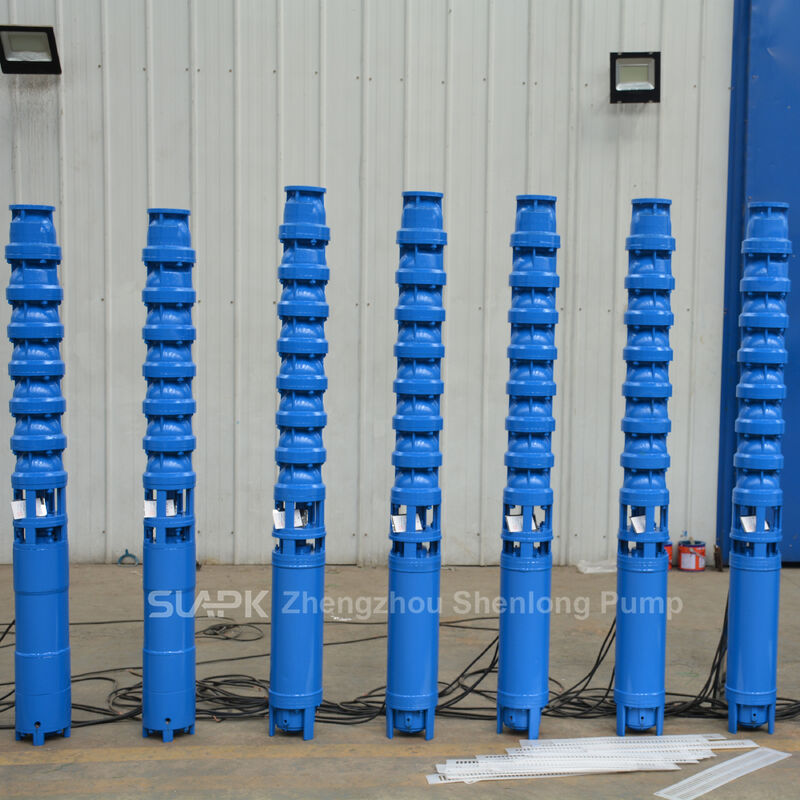
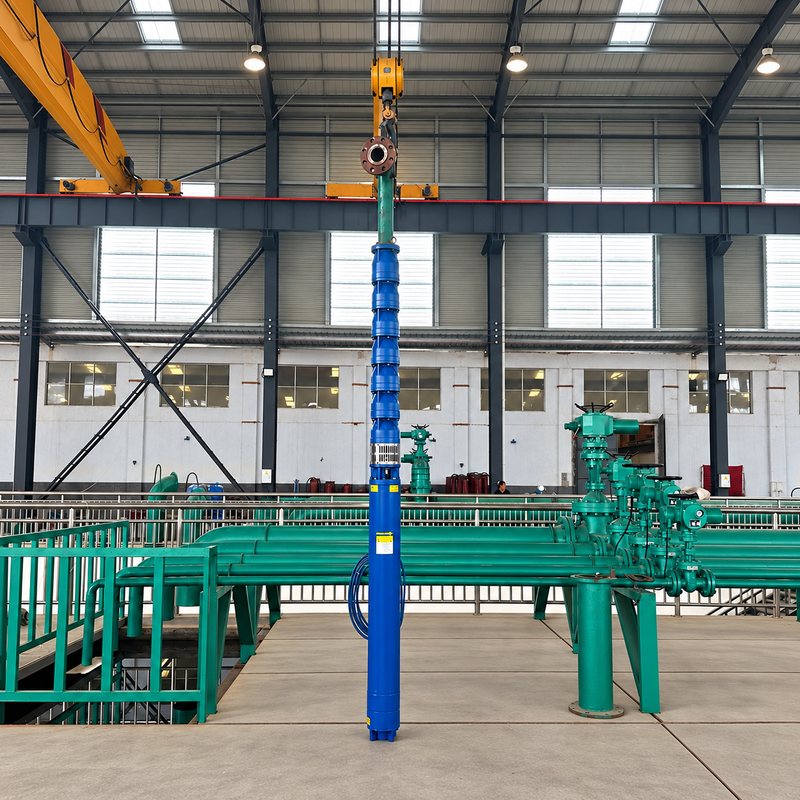
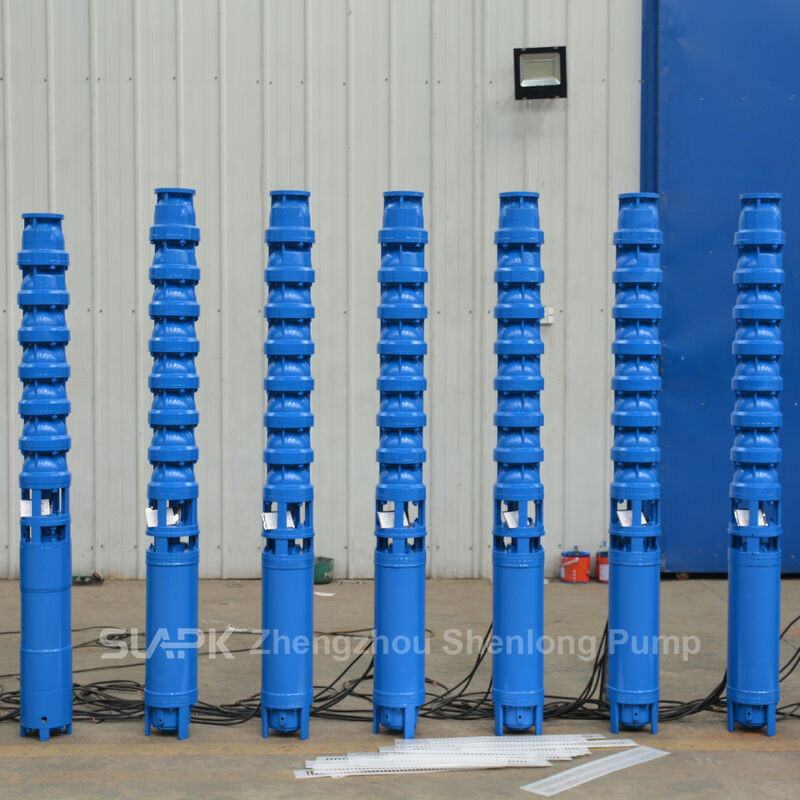
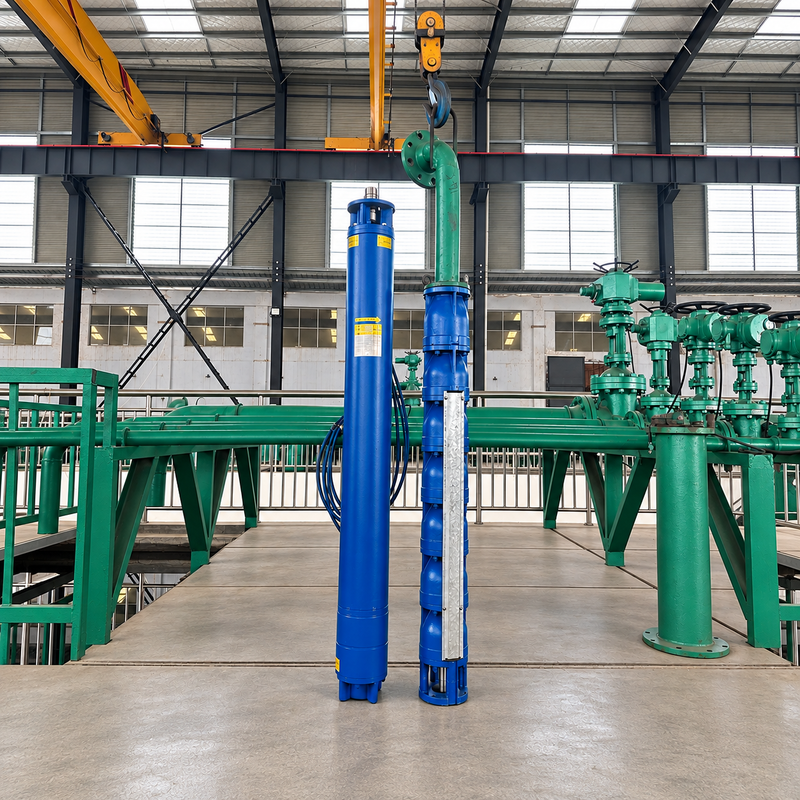
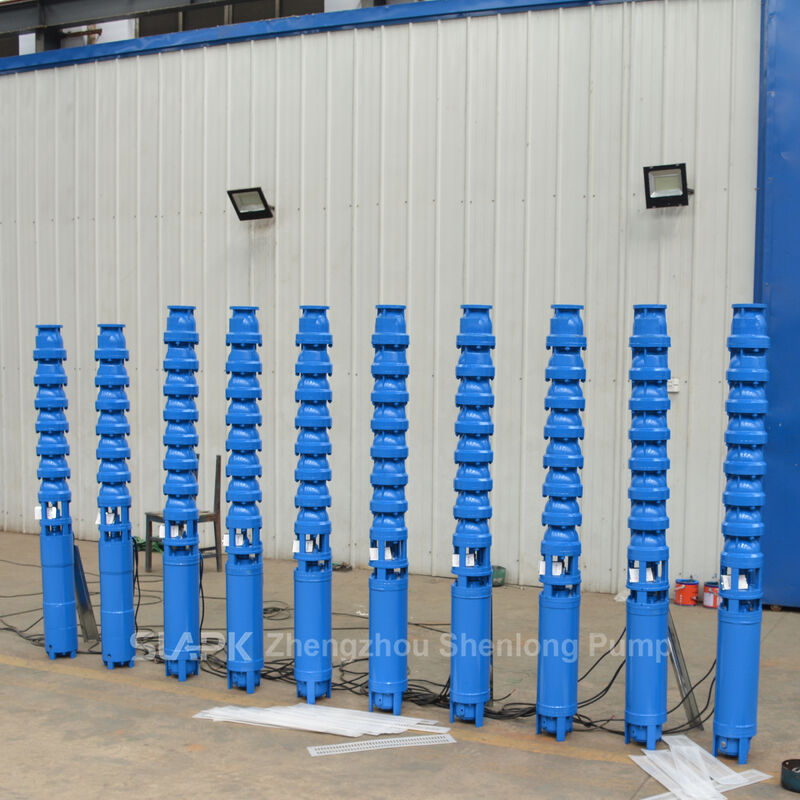
When the sprinklers near the well operate normally but those at the far end of a field receive too little pressure, the first question is where the pressure is being lost. The well, delivery main, filters, elevation and active nozzle count all affect the answer. We assess the SLAPK 200QJ63-154/11 for direct sprinkler supply by checking the field’s actual flow and pressure requirements against the pump curve.
This model has a 45kW motor, a nominal flow of 63 m³/h and a nominal head of 154 m. The nominal head is the pump’s designation. Only part of that head is available as pressure at the sprinklers after lifting water from the well and conveying it to the field.
Technical Specifications
Model: 200QJ63-154/11
Motor power: 45 kW
Nominal flow and head: 63 m³/h and 154 m
Catalog flow range: 58–68 m³/h
Catalog head range: 130–180 m
Discharge outlet: 4 inches
Series: QJ, with cast hydraulic components
We confirm the pump body and impeller materials for the water being pumped. Voltage, frequency, phase and control equipment are specified for the quoted motor. The catalog ranges do not guarantee 68 m³/h at 180 m head; the selected flow and head must correspond on the same curve.
Select for the Sprinklers That Run Together
For a zoned irrigation system, multiplying every sprinkler on the farm by its nozzle flow can substantially overstate pump demand. Suppose 30 sprinklers are divided equally between three zones, and each nozzle requires 6 m³/h at its specified inlet pressure. Running one zone requires 60 m³/h. Running two at once requires 120 m³/h, which is outside this model’s catalog flow range.
That is why we ask for the zone schedule as well as the nozzle data sheet. In this example, the pump can be evaluated for one-zone operation, subject to the head check. If the farm needs two zones together, that operating arrangement requires a different selection review. Additional motor power alone does not establish the required flow.
Check Pressure at the Most Demanding Sprinkler
The wellhead gauge shows pressure at one location. The sprinkler manufacturer specifies pressure at another: the nozzle inlet. Between them, water may pass through a filter, a control valve, a long main and an uphill branch. A satisfactory wellhead reading does not by itself confirm satisfactory nozzle pressure.
For a new system, send us the elevation and pipe route to the most demanding sprinkler in each main operating zone. For an existing system, pressure readings taken while the same zone is running are especially useful. Note where each reading was taken: at the wellhead, before or after the filter, or near the last sprinkler. Readings taken with the zone closed do not describe the losses during irrigation.
The Largest Zone and the Highest Field Can Be Different Duties
A large zone near the well may need the greatest flow. A smaller zone farther uphill may need greater head despite having fewer sprinklers. We treat these as two operating points: the flow and head of the large zone, and the flow and head of the uphill zone. Combining the highest flow from one with the highest head from the other can produce a duty that never occurs on the farm.
The pumping water level can also change between the start of the irrigation season and peak demand. If you have a well-test record, send the measured flow and corresponding pumping water level. This helps us check whether the source can sustain the zone demand and whether the additional seasonal lift changes the pump selection.
Comparing Two 45kW Irrigation Pump Options
The 200QJ63-140/10 and 200QJ63-154/11 share a 45kW motor rating, a 4-inch outlet and a catalog flow range of 58–68 m³/h. Their catalog head ranges differ: 120–164 m for the 140/10 and 130–180 m for the 154/11.
For example, if your design calls for 60 m³/h at 150 m total head, both models pass an initial range check. We would compare their curves at 60 m³/h before proposing either one. For an existing installation, we would also review the pipe pressure rating, electrical supply and controls. Matching the old motor rating and outlet size does not settle those questions.
What to Specify for a Replacement or a New Irrigation Network
For a replacement, tell us whether the original arrangement ever met the irrigation requirement. If performance changed without any extension to the field, recent pressure readings, pumping water levels and filter condition are useful. If larger nozzles or additional fields have been added, send the revised demand instead of ordering solely from the old nameplate.
For a new network, identify which party is supplying the pump, motor cable, starter or control panel, filters and field valves. If automatic zone changes or variable-speed operation are required, describe the intended sequence. We can then review the pump and motor operating limits and state the proposed controls in the quotation.
Frequently Asked Questions
If the well pump only fills a farm reservoir, should nozzle pressure be included?
If the well pump discharges freely into an open reservoir and a separate booster supplies the sprinklers, we assess the well pump against the reservoir-filling duty. Nozzle pressure belongs to the booster system in that arrangement. Tell us whether the well pump feeds storage or the field directly.
Does a catalog head of 180 m mean the pump suits any 180 m well?
No. Well depth does not identify the pumping water level, field elevation, pipe losses or nozzle pressure. We need those figures to check hydraulic performance. Installation depth and well clearance are separate checks.
Can we keep the existing 4-inch main and control panel?
Possibly. Send the pipeline length, internal diameter and pressure rating, along with the cable length, supply voltage, frequency and control panel specification. We review these against the proposed configuration before identifying what can be reused.


 Your message must be between 20-3,000 characters!
 english
 français
 Deutsch
 Italiano
 Русский
 Español
 português
 Nederlandse
 ελληνικά
 日本語
 한국
 العربية
 हिन्दी
 Türkçe
 indonesia
 tiếng Việt
 ไทย
 বাংলা
 فارسی
 polski